Forty-six new letters, each one a set of strange little lines. If your child tried to learn katakana one letter at a time from a flashcard stack, you may have watched the excitement fade somewhere around ケ. That is not a lack of effort. It is how memory works.
Why one letter at a time feels so heavy
A single katakana letter on its own has nothing to hang on to. ハ is just two lines. It has no picture, no meaning and no story, so the only way to keep it is pure repetition. Now multiply that by 46, add another 46 that look a bit alike, and the pile grows faster than a child can carry it. Psychologists have found that we can only hold a handful of new things in mind at once (Cowan, 2001), so a long list of unconnected shapes is exactly the kind of load that leads to “I can’t do this.”
Children don’t remember things one by one in empty space. They remember things that are connected: a picture, a sound, a word they already love. That is where the research gets encouraging.
What the research says
1. Two kinds of memory are better than one. Psychologist Allan Paivio’s dual coding theory describes two linked memory systems: one for words and one for images. When something is stored in both, there are two paths back to it, so it is easier to recall (Clark & Paivio, 1991). A picture of a banana, the spoken word “banana,” and the letters バナナ all point to the same thing, and each one helps the others.
2. Letters stick when they are tied to something meaningful. In a classic study, children learned letter sounds better when each letter was drawn as part of a familiar picture (like an “s” shaped into a snake) than when they saw the same letters with unrelated pictures or with no pictures at all (Ehri, Deffner & Wilce, 1984). The picture gave the shape a meaning to hold on to.
3. Seeing the letters helps children remember the word itself. When second and fifth graders learned new words, the ones who also saw how each word was spelled remembered the pronunciations and meanings better than those who only heard the words (Rosenthal & Ehri, 2008). Reading researcher Linnea Ehri describes how this works: as children connect the sounds of a word they know to the letters on the page, the spelling gets “glued” to the word in memory. This process is called orthographic mapping (Ehri, 2014). So the word helps the letters, and the letters help the word.
4. Many short meetings beat one long session. Words and letters are not usually learned in a single moment. Children reading new words remembered more of them after four encounters than after one or two (Nation, Angell & Castles, 2007). And even three-year-olds remembered more when the same items were spread out over time instead of crammed together, although spacing felt harder in the moment (Vlach, Sandhofer & Kornell, 2008). A little bit, often, is how memory is built.
5. Japanese children absorb kana early, too. In Japan, hiragana is formally taught in first grade. Yet in a large survey by Japan’s National Institute for Japanese Language, five-year-olds could already read about 66 of 71 hiragana on average (Shimamura, reporting the 1988 survey). Children growing up in Japan meet these letters every day, in picture books, on signs and on snack packages, long before they sit down to study them.
One honest catch: point to the letters
There is an important twist. Pictures can also steal attention. In early studies, children who learned words with a picture next to them sometimes looked at the picture, guessed the word, and never really learned the letters. When the picture was taken away, they couldn’t read the word (Samuels, 1967). Similarly, preschoolers who could “read” logos and signs often could not read the same word once the logo and colors were removed, and didn’t notice when a letter was changed (Masonheimer, Drum & Ehri, 1984).
So the picture is a doorway, not the destination. The picture brings meaning and fun. Then, gently, guide your child’s eyes to the letters: point, read them aloud together, and let your child find them again somewhere else.
See it, then write it
The best way to move a child’s eyes from the picture to the letters is to have them write the word. To copy ツリー, you have to look closely at every stroke, and you can’t do that while only looking at the tree.
Research on handwriting backs this up. Preschoolers who practiced letters by writing them by hand later recognized those letters better than children who practiced by typing them (Longcamp, Zerbato-Poudou & Velay, 2005). In a brain imaging study, five-year-olds who had printed letters by hand showed more activity in brain areas used for reading when they later looked at letters. Children who had only typed or traced the letters did not show the same boost (James & Engelhardt, 2012).
So tracing is a great start, but the real step is writing the letters on their own. Look at the picture, say the word, trace it, then write it in an empty box.
Why adults can learn a word from letters alone
You may have noticed that adults can often learn a new word just by reading it, while young children need much more. One reason is what is already in our heads. When we read a word we already know by sound and meaning, the letters have something to attach to. Researchers have found that children, too, read a new written word more easily when they have already heard it and know what it means (McKague, Pratt & Johnston, 2001; Duff & Hulme, 2012). They even form expectations of how a word they have only heard will be spelled (Wegener and colleagues, 2018).
Adults carry a huge store of words and images, so they can connect new letters to them quickly. A young child learning Japanese has a much smaller store, especially in their second language. The picture and the spoken word fill that gap: they put the meaning in place first, so the letters have somewhere to land. That is good news for katakana in particular, because ツリー is “tree,” a word your child already knows.
Putting it together: thing, word, letters
Think back to when your child was first learning to talk. You didn’t teach the word “apple” from a list. You held up a real apple and said, “Apple! Do you want some apple?” The thing and the word arrived together, again and again, until the word stuck.
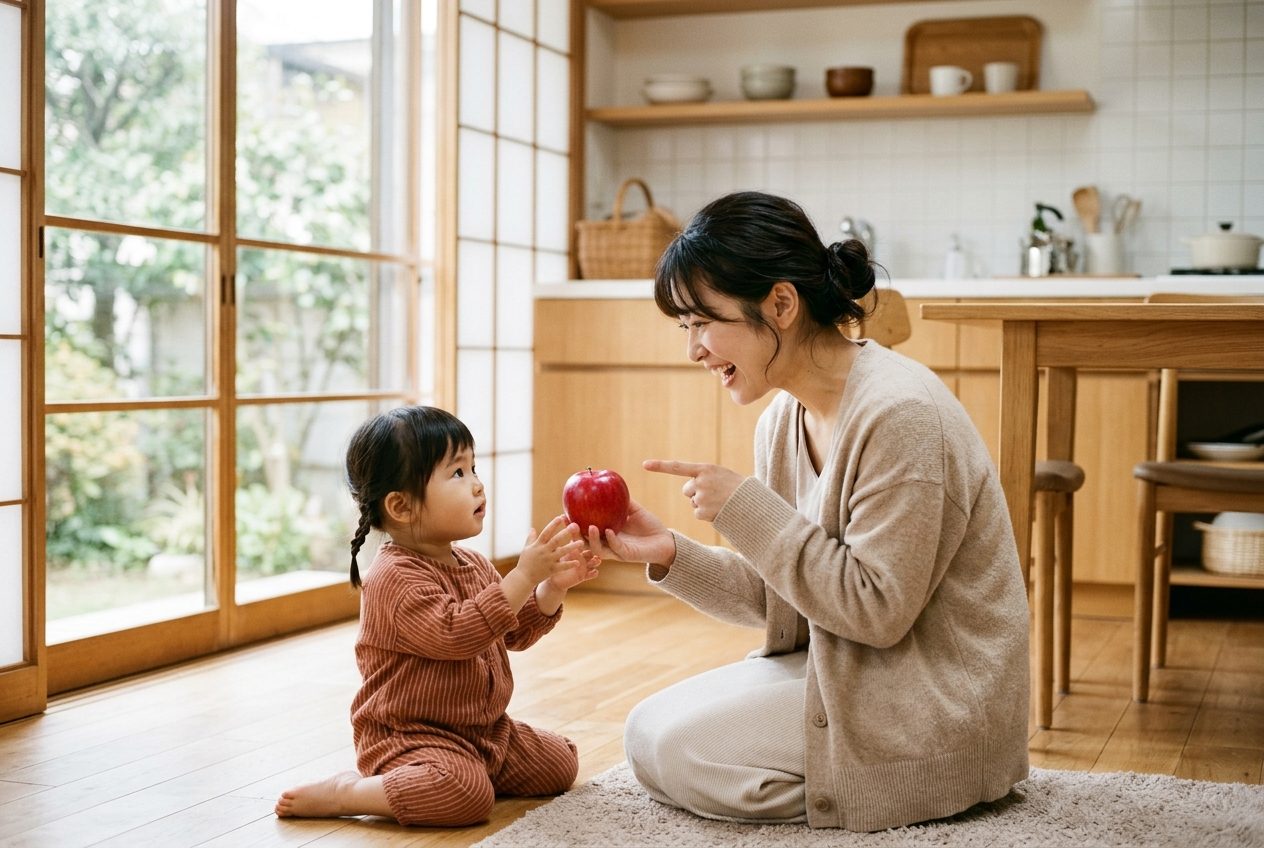
Learning to read can work the same way. We are simply adding one more piece to that familiar moment: the letters. The apple, the word “apple,” and now the written word, all at once.
Instead of 46 isolated shapes, think in small, happy bundles: the thing (a picture or the real object), the word (said aloud), and the letters (seen and pointed to), all at the same time. Then meet that bundle again tomorrow, and next week.
Coloring: noticing letters without drills
Coloring is one of the easiest ways to do this. While your child colors a Christmas tree, the word ツリー sits right under the picture, drawn in outline so it can be colored in too. They look at it again and again for several minutes, without any pressure to “study.” Many children start recognizing letters they never sat down to memorize.
Then comes the “see it, then write it” step. In our Christmas Katakana book, every coloring page has a matching practice page with the same word, a short phrase, and boxes to trace and then write it.
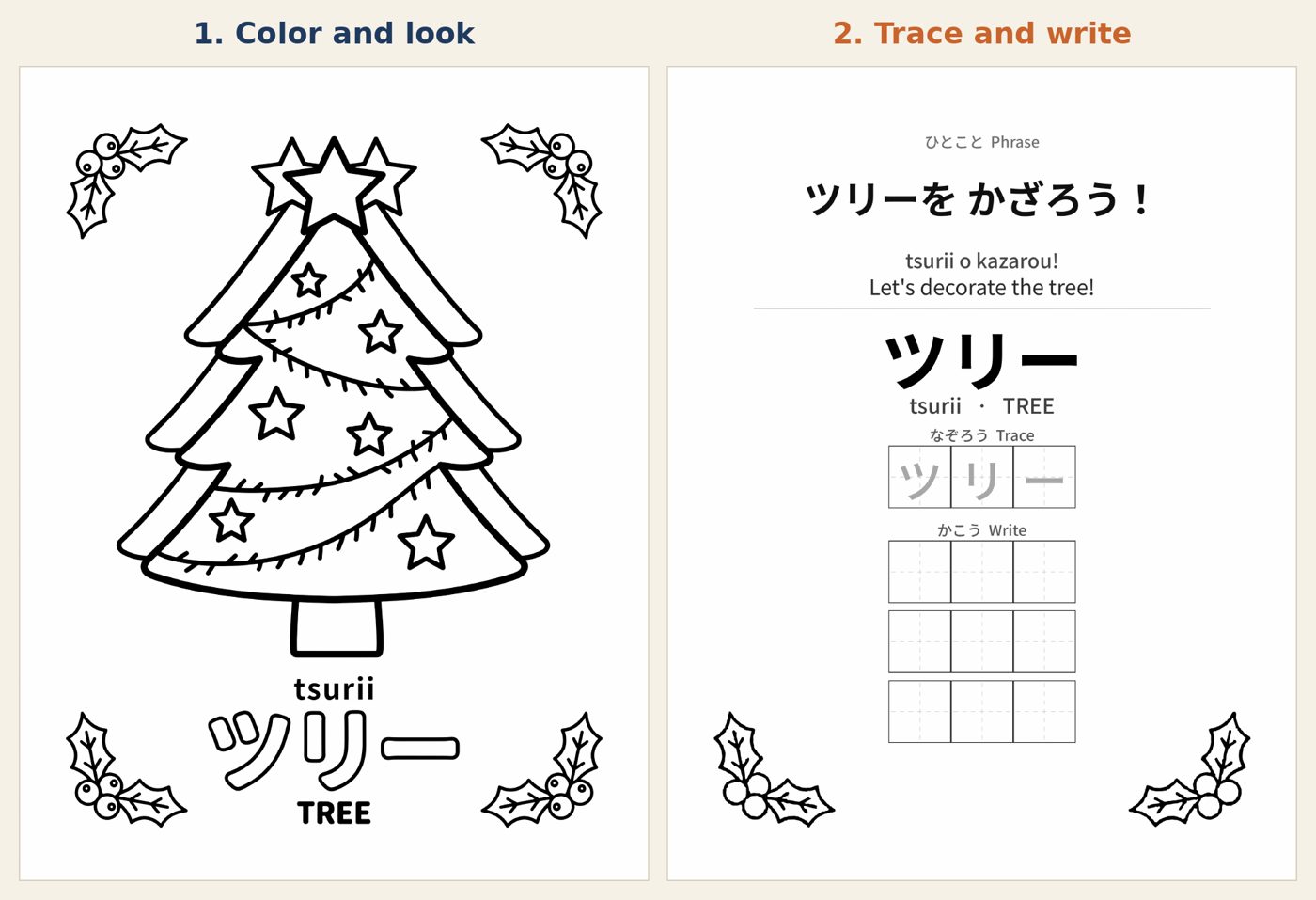
Our Christmas Katakana Coloring Pages (50 Christmas words, each with a coloring page and a trace-and-write page) and the Winter Japanese Bundle are made for exactly this. For a calmer, cultural option, the Kimono & Seasons coloring book is designed for adults and kids to color together, which is a lovely way to sit side by side and talk about what you see. Because it is a printable PDF, you can print the same page as many times as you like: color the same picture, one each, and enjoy comparing your colors. You can find all our printable coloring books in our Etsy shop.
Tip: when a page is finished, ask your child to point to one letter and find it again on another page. That small step turns the picture into letter practice.
Katakana sticky notes around the house
Many everyday things in a home already have katakana names, and most of them sound like English:
- テレビ (terebi): TV
- ドア (doa): door
- ベッド (beddo): bed
- ソファ (sofa): sofa
- テーブル (tēburu): table
- カップ (kappu): cup
- スプーン (supūn): spoon
- トイレ (toire): toilet
Write each word in big letters on a sticky note and put it on the real object. Now the thing, the word and the letters live together, and your child walks past them every day.
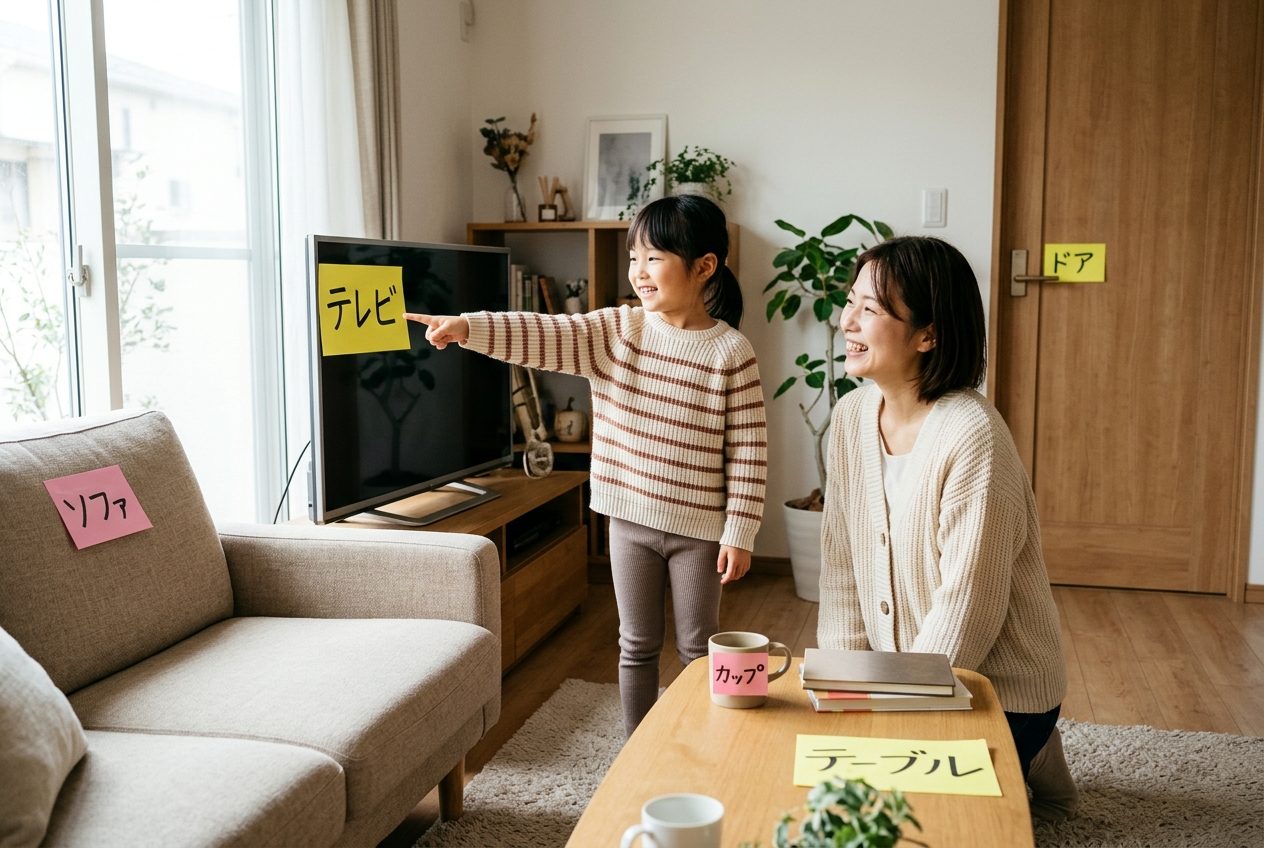
To make it work even better:
- Start with five or six notes, not the whole house.
- Read a note together whenever you use the object. “ド・ア, door!” Point to each letter as you say it.
- Play “label shuffle” once a week. Take the notes off, mix them up, and let your child put each one back on the right object. Without the object to lean on, they have to read the letters, which is exactly the skill we want (remember the logo study above).
- Add a few new notes each week and keep the old ones up for review.
- Let your child write the next note. Copying a word they chose is a big, proud step.
Workbooks: when letters are ready for the pencil
Once a few letters feel familiar, writing them locks them in. Our Nihongo Kazoku textbooks introduce katakana inside real words and conversations: the first 28 letters in Book 3 and the last 18 in Book 4. For extra writing practice, Japanese Letter Writing Practice: Katakana has picture words, easy sentences and katakana checks. View on Amazon →
Teens and adult learners can try our printable Katakana Workbook, which builds from the basics to full sentences.
For a step-by-step plan, stroke order tips and the letters kids mix up most, see How to Teach Katakana to Kids.
A printable hiragana and katakana chart, stroke order practice for all 46 katakana, and a page of ア イ ウ エ オ picture words (4 pages, PDF). Stick the chart on the fridge next to your sticky notes. Get the free set →
Studies mentioned
- Clark, J. M., & Paivio, A. (1991). Dual coding theory and education. Educational Psychology Review, 3(3), 149–210.
- Cowan, N. (2001). The magical number 4 in short-term memory. Behavioral and Brain Sciences, 24(1), 87–114.
- Duff, F. J., & Hulme, C. (2012). The role of children’s phonological and semantic knowledge in learning to read words. Scientific Studies of Reading, 16(6), 504–525.
- Ehri, L. C. (2014). Orthographic mapping in the acquisition of sight word reading, spelling memory, and vocabulary learning. Scientific Studies of Reading, 18(1), 5–21.
- Ehri, L. C., Deffner, N. D., & Wilce, L. S. (1984). Pictorial mnemonics for phonics. Journal of Educational Psychology, 76(5), 880–893.
- James, K. H., & Engelhardt, L. (2012). The effects of handwriting experience on functional brain development in pre-literate children. Trends in Neuroscience and Education, 1(1), 32–42.
- Longcamp, M., Zerbato-Poudou, M.-T., & Velay, J.-L. (2005). The influence of writing practice on letter recognition in preschool children: A comparison between handwriting and typing. Acta Psychologica, 119(1), 67–79.
- Masonheimer, P. E., Drum, P. A., & Ehri, L. C. (1984). Does environmental print identification lead children into word reading? Journal of Reading Behavior, 16(4), 257–271.
- McKague, M., Pratt, C., & Johnston, M. B. (2001). The effect of oral vocabulary on reading visually novel words: A comparison of the dual-route-cascaded and triangle frameworks. Cognition, 80(3), 231–262.
- Nation, K., Angell, P., & Castles, A. (2007). Orthographic learning via self-teaching in children learning to read English. Journal of Experimental Child Psychology, 96(1), 71–84.
- Rosenthal, J., & Ehri, L. C. (2008). The mnemonic value of orthography for vocabulary learning. Journal of Educational Psychology, 100(1), 175–191.
- Samuels, S. J. (1967). Attentional process in reading: The effect of pictures on the acquisition of reading responses. Journal of Educational Psychology, 58(6), 337–342.
- Shimamura, N. (c. 1998). 文字習得のふしぎ [The mystery of learning letters]. National Institute for Japanese Language and Linguistics.
- Vlach, H. A., Sandhofer, C. M., & Kornell, N. (2008). The spacing effect in children’s memory and category induction. Cognition, 109(1), 163–167.
- Wegener, S., Wang, H.-C., de Lissa, P., Robidoux, S., Nation, K., & Castles, A. (2018). Children reading spoken words: Interactions between vocabulary and orthographic expectancy. Developmental Science, 21(3), e12577.
This page contains promotional content / affiliate links.